

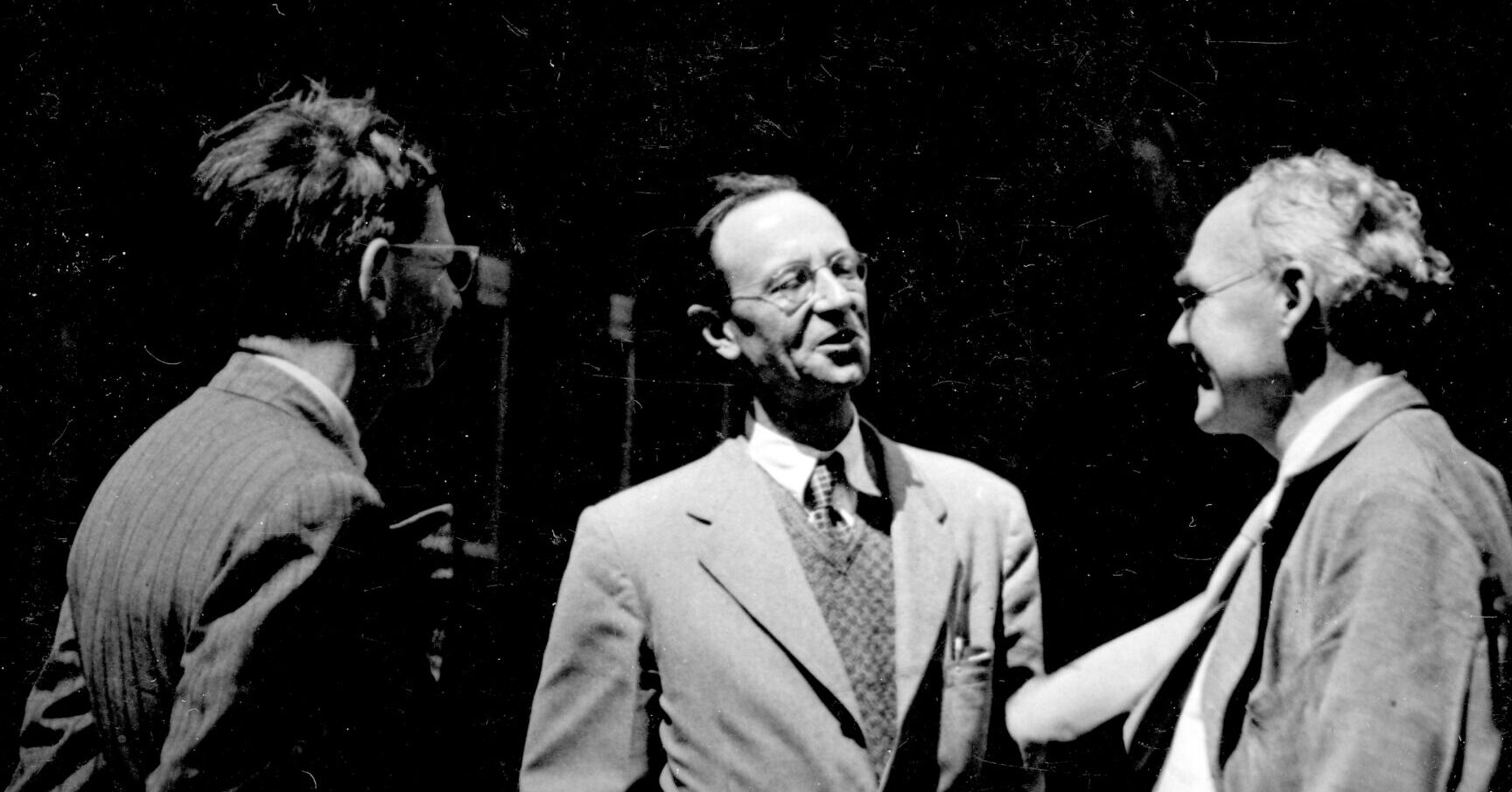
By Andrew Brown, Archives Centre researcher and author of ‘The Neutron and Bomb: A Biography of Sir James Chadwick’ (Oxford, 1997)
On 10 May 1941, the Trinity College physicist and the world’s leading expert on explosions, Geoffrey Ingram Taylor sat down to write a note to Professor James Chadwick. Chadwick, the discoverer of the neutron, was professor of physics at Liverpool University. He was also a member of the secret Maud Committee, charged with coordinating the research that was going on in several British universities to develop a uranium bomb. In the spring of 1941, Chadwick realised ‘that a nuclear bomb was not only possible – it was inevitable.‘ While fundamental questions remained on the feasibility of an atom bomb, Chadwick wanted to know how powerful its blast might be. So, he asked G.I. Taylor, who was not a member of the Maud Committee but served on numerous other committees advising the military and Ministry of Supply on munitions and bomb damage.
Taylor always preferred to work from his Cambridge home, Farmfield; he employed no secretary so that nearly all his substantial output was handwritten and he kept no copies. He entrusted the letter to the mail, addressed to Chadwick in Liverpool. Although the city had been blitzed every night for the first eight days of May and life there was chaotic, the note was soon delivered. Its content would be presented to the Maud Committee at their London meeting on 19th May 1941.
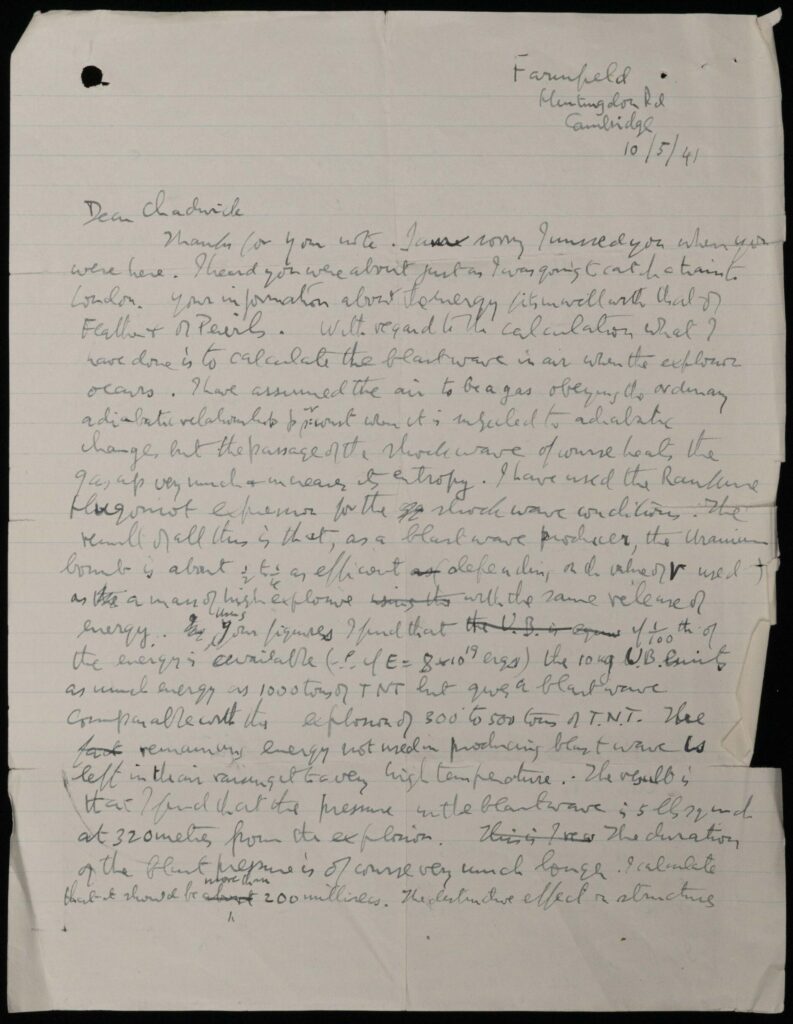
Taylor made use of the nineteenth-century Rankine-Hugoniot equation that links the overpressure associated with a shock wave to its velocity through air. He assumed a uranium bomb would be 50-75 per cent less efficient than a mass of conventional high explosive ‘as a blast wave producer’. Using data provided by Chadwick, Taylor calculated that a 10kg uranium bomb would release as much energy as 1,000 tons of TNT, ‘but gives a blast wave comparable with the explosion of 300 to 500 tons of TNT. The remaining energy not used in producing a blast wave is left in the air raising it to a very high temperature.‘ Taylor also pointed out that the duration of a shock wave resulting from nuclear fission is longer-lasting than from a chemical explosive so the destructive effect on structures is magnified. His conclusions would become an appendix to the Maud Report and provide the basis for its estimate of damage.
In August 1939, Einstein wrote to Roosevelt raising the possibility of a uranium bomb that he thought would have to be delivered by ship because it would be so massive. A memorandum written by Otto Frisch and Rudolf Peierls at Birmingham University in March 1940 identified the U-235 isotope as the active constituent for such a bomb. They predicted if the isotope, which constitutes less than one per cent of naturally occurring uranium, could be separated as an enriched fuel, its critical mass might be as low as 10kg. One year later, Taylor had calculated its explosive force.
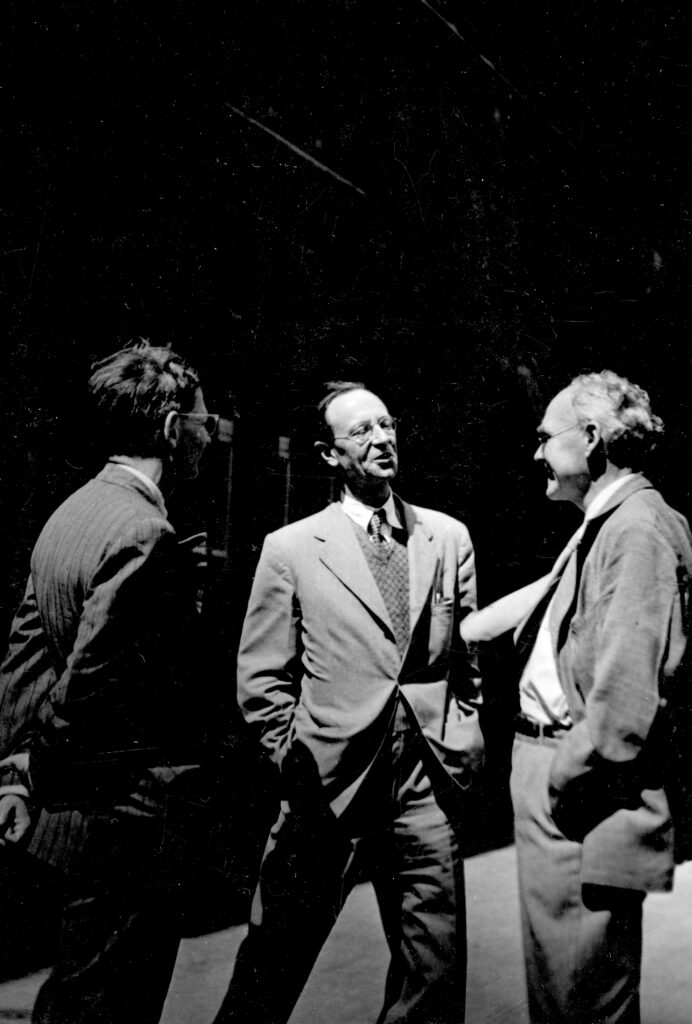
In the summer of 1944, Taylor visited Los Alamos to advise the Manhattan Project on the critical issue of detonating a proposed plutonium bomb by implosion. General Groves and Oppenheimer soon wanted Taylor to return. Chadwick, the chief British scientist, was caught in a high-level diplomatic row. He explained to Sir Edward Appleton in April 1945, ‘Groves has put in a strong plea for G.I. Taylor…The visit is so much desired by the Americans and might be so important to the project, that anything short of kidnapping would be justified.’ Taylor resisted on the grounds that the chances of him adding any worthwhile insights overlooked by the great physicists already working on the Manhattan Project were negligible, but by June he was forced to join them.
Dr Andrew Brown, June 2026
G.I. Taylor is one of the five Cambridge scientists who are the subjects of Brown’s forthcoming book, Savants of Science and Warfare.