

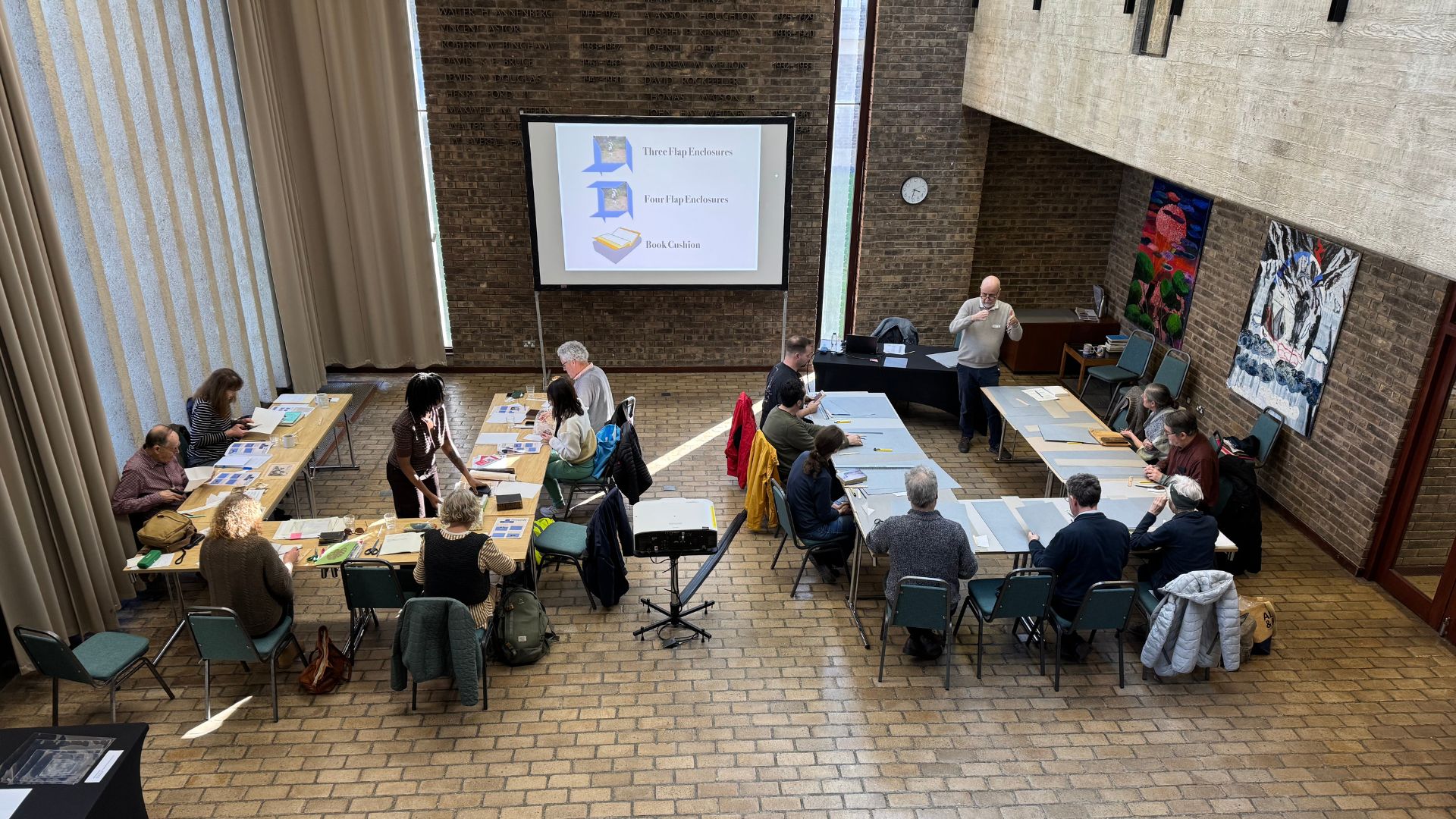
As part of the Cambridge Festival 2026 Churchill Archives Centre collaborated with Cassia Clarke, independent community archivist, to host a workshop on caring for photographs and other archive material at home. The workshop was supported by Cambridge Curiosity and Imagination.
Here Cassia shares some of the tips and techniques covered in the workshop, as well as downloadable PDFs (handouts from the workshop).
Handling
How we handle our photographs is a contributing factor to a photograph’s longevity.
Hands can transfer harmful substances, such as dirt, dust, fingerprints, skin cells and oils, onto the surface of photographs which can contribute to its deterioration. First and foremost, clean and dry hands are a must.
You can use nitrile gloves (typically available at your local pharmacy), and/or make handling materials with archival safe paper. Paper tweezers act as a barrier between your hand and the photograph, allowing you to hold a photograph safely. A paper spade helps you flip a photograph.
If you do not have archival safe paper to hand, simply handling your photographs by the corners also works.
Documentation
Contextualising your photographs is good practice. Failing to contextually document a photograph necessitates the importance of our memory, even in the face of age and health implications on that memory.
Writing down simple reminders like who is in the photograph, when and where it was taken will be valuable information to have.
If you use archival safe adhesive labels to write the photographs’ information on, please refrain from placing the label directly on the photograph. Instead, attach it to your archival packaging material (i.e., the paper enclosure) to prevent potential damage to your photographs.
Alternatively, you can softly write context onto to the back of your photographs using a soft 2B pencil or directly onto the paper enclosure packaging.
Packaging and storage
It is important to be considerate of how we store our photographs at home. Below, we offer two enclosures made with archival paper. These enclosures are environmentally friendly and offer great protection. As an alternative, you can use sleeves made from archival safe plastic (such as melinex or polypropylene).
It is recommended to store your photographs in stable, naturally cool and dry environments. Avoid basements, lofts, radiators and direct sunlight. When storing photographs in boxes (archival or not) ensure your photographs are flat and are physically supported as movement can cause damage.
Session summary sheet
It is important to remember that nothing is designed or able to last forever, and that includes photographs. The best we can do is utilise what we can and where we can to slow a photograph’s deterioration.
By Cassia Clarke [email protected]
You can find Cassia on Instagram @cassia_clrk, or on LinkedIn
Cassia’s book ‘Preserving the Familial Archive: The guidebook to archival practices in your home’ is available via her website https://cassiaclarke.squarespace.com/