

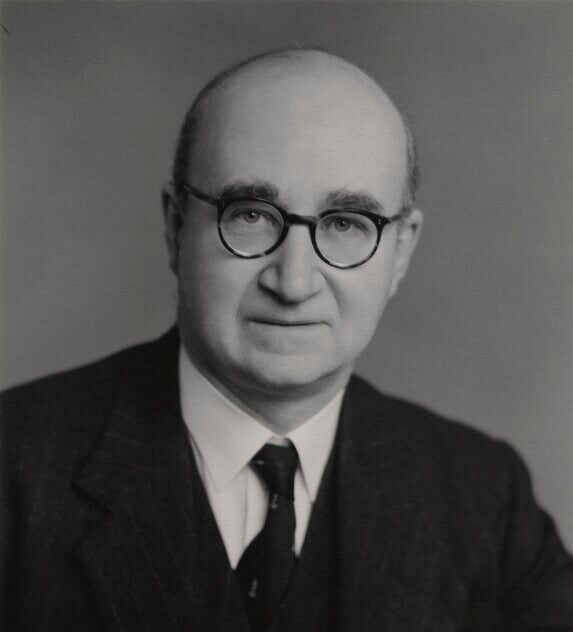
Photograph of Sir Eric Seal, by Walter Stoneman (bromide print, 1955, NPG x185197)
© National Portrait Gallery, London
We are lucky enough to have the archives of many of Sir Winston Churchill’s secretaries here at the Archives Centre, and very useful they are too: these were people who worked closely with Churchill, some of them at the height of the war, and their private letters and diaries (where they kept them, which they weren’t really supposed to) are a goldmine for researchers.
Our most recent accession is a small archive from Sir Eric Seal. Seal was Churchill’s Principal Private Secretary in the early years of his premiership, having been with him since the very start of the war, when Churchill was brought back to the Cabinet as First Lord of the Admiralty. Like most of the Civil Service, Seal was initially pretty dubious about his new boss, but Churchill clearly valued his services (remarking that he was happy to name a submarine HMS Seal, ‘as it was so appropriate. I lurked beneath the surface, & intervened with force on occasion.’ When Churchill became Prime Minister in May 1940, he took Seal with him, and Seal stayed at his post until the following year, when in May 1941 Churchill appointed him as Deputy Secretary of an Admiralty mission to the United States, particularly to help negotiate the Lend-Lease aid agreement.
Seal is perhaps not the best-known of Churchill’s staff, as unlike Jock Colville, say, he never published an account of his time with him. As the Principal Private Secretary at a time when Churchill was setting up his Private Office, however, his insights are exceptionally valuable. You always hope to find some personal material in this sort of archive, and sure enough, there is a splendid file of Seal’s wartime letters to his wife. These letters contain some lovely glimpses of his boss, whom Seal seems to have found lovable and exasperating in equal measure, just as the rest of Churchill’s staff did.
Here he is describing one rather uproarious staff party, while Churchill ‘was dining alone with his thoughts & Clemmie in the rooms below. Anyway, at 9.30 he was discovered, morose & unhappy, stalking up & down the passage, exclaiming that no one was looking after him, & that he had been deserted!! As he had only to send a marine up one flight of stairs to have anybody or anything he wanted, that was a trifle hard; but later on he warmed up, & became quite happy again. He really is fond of congenial companions & a fearful babe.’ (SEAL 2/1)
Besides these letters to his wife, Seal also kept some marvellously gossipy letters from his fellow secretaries, who obligingly sent him all the office news after his departure for Washington, and also a couple of fascinating memoranda which he sent to Churchill himself, making suggestions on the course of the war. Better still, Churchill has paid him the compliment of annotating one of these memoranda in his own hand, even if these annotations are not especially polite, responding for instance to Seal’s view that American forces should help in West Africa with the remark that it was no use badgering them to do what they knew already, and to the suggestion that American influence should be brought to bear on the Soviet Union with the comment ‘What good would that do‘).
Besides these gems, there is also a detailed draft memoir about the war years, though sadly Seal doesn’t seem to have had time to finish it before his death in 1972. Here again Churchill features pretty largely, and not for the first time, we see him unclothed: Seal includes one story of him bursting out of the bathroom at Admiralty House ‘naked in a shower of splinters’ after losing patience with the lock, and another about Churchill shouting from the top of the staircase whether the valet thought he could go to the Cabinet without any trousers on.
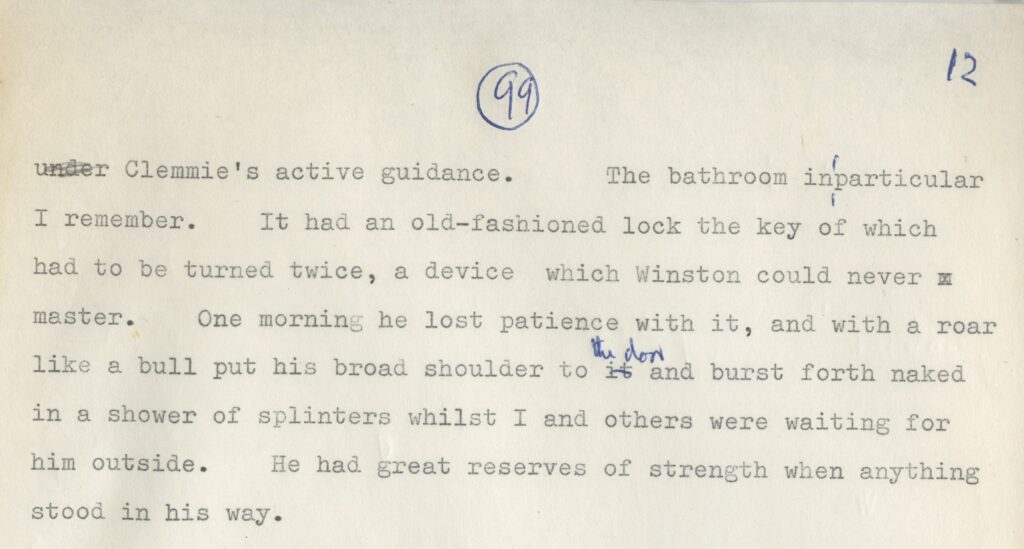
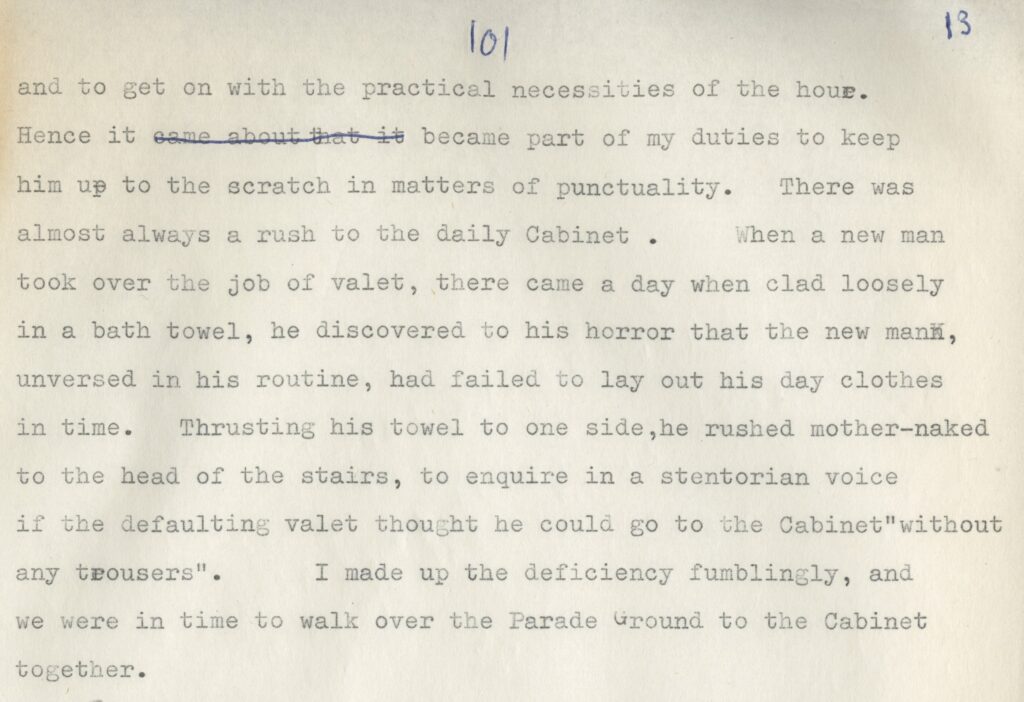
Not altogether unsurprisingly, Seal remembers ‘one occasion at least, before I knew him well, and when I felt myself to be on a lonely watch late at night, when I was reduced to wondering what the correct procedure was if it became apparent to the Private Secretary that the First Lord was not entirely responsible for his actions! I wondered what the reactions of the Prime Minister would be, if approached late at night by a very junior Civil Servant with the story that one of his senior ministers had gone off his head!’
Fortunately it does seem as if Seal changed his mind about Churchill once he knew him a little better, or at least became used to his eccentricities, and became a wholehearted admirer.
Katharine Thomson, July 2026