
By Richard Simpson who is currently researching and writing a biography of Charles Merz
The development of Britain’s electricity supply industry is a fascinating story of clashing vested interests, muddled legislation and the drive of a small number of men pushing the nation, often kicking and screaming, into the 20th Century.
The most important of these men was Charles Hesterman Merz. He is arguably the most important early pioneer of Britain’s electricity supply industry. In his day he was known as the “Grid King” because he envisioned and brought about the National Grid – a system of large, centralised and interconnected power stations linked by the high voltage network of power lines, pylons and substations we see can still see today.
And yet Merz, arguably Britain’s greatest ever electrical engineer, is almost a forgotten figure today. His remarkable contribution to his country is not celebrated anywhere, even in his home town of Newcastle upon Tyne.
Merz was born in Gateshead in 1874. His father was of German descent and his mother was a member of a distinguished and wealthy Quaker family called the Richardsons. His father played a major role in the development of the electricity supply industry on Tyneside, being one of the founding shareholders and directors of Joseph Swan’s incandescent electric lightbulb business and also the Newcastle Electric Supply Company (NESCo), which became the largest electricity supply undertaking in the first decades of the 20th Century.
Charles was apprenticed to NESCo in 1892 after dropping out of college. Electricity supply was a very primitive affair in those days. Producers had to apply to Parliament for permission to generate and distribute electric current, but only within existing local authority boundaries and only for lighting.
Electric tramways and railways were dealt with separately.
The nascent industry was ripe for someone of Charles’s systemising talents to disrupt. After his apprenticeship he moved to London for the British Thomson-Houston (BTH) company, an American-German business supplying equipment and materials to the burgeoning industry. Charles worked at Bankside and Croydon power stations before being sent to Cork in Ireland to project manage a tramway and lighting scheme on behalf of BTH.
In Cork he began to experiment with the idea of providing bulk electricity to industry, as opposed to businesses generating their own supply.
He was called back to Tyneside by an uncle who was a director of a local gas company. The gas company wanted to diversify into electricity and asked Charles to help it apply for the necessary powers to Parliament. Aged only in his mid-twenties he prepared the application then appeared before committees of MPs as the key witness in support of the application.
The result was the development of the Neptune Bank Power Station which was inaugurated by Britain’s foremost physicist Lord Kelvin in 1901. Neptune Bank was the first power station in Britain to utilise three-phase alternating current. This allowed the station to supply current for lighting, traction and industrial power. Factories and shipyards along the north bank of the River Tyne were the first in the country to benefit from the supply of bulk electricity to run their motors. The supply of bulk electricity was a major factor in the development of mass production techniques as pioneered by Henry Ford in the US.
Charles set up his own electrical engineering consultancy with his friend and colleague William McLellan. Working closely with NESCo they began to expand operations across the whole of the North East region. It became the template for the National Grid that Charles brought into existence.
He also tackled the thankless task of bringing order from the chaos of London’s electricity supply infrastructure. As well as continually pushing for standardisation and efficiency, he was the mastermind behind Barking Power Station. He also worked abroad, mainly in Britain’s dominions. Australia and South Africa in particularly benefited from his genius, but he also worked on electric railway schemes in Argentina and India.
In 1931, Charles received the Faraday Medal, the highest honour of the Institution of Electrical Engineers.
There is so much more he achieved but space does not allow a fuller account.
Churchill Archives Centre has been an important source of information relating to three men and their connection with Charles.
Firstly, the archive contains the papers of a talented physicist named Graeme Haldane, a nephew of the great Liberal politician Richard (Lord) Haldane, who became a partner in Merz and McLellan.
Next, it also holds the papers of Lord Weir, an industrialist and politician who chaired the committee that created the 1926 Act of Parliament which moved Britain’s electricity industry ever closer to nationalisation.
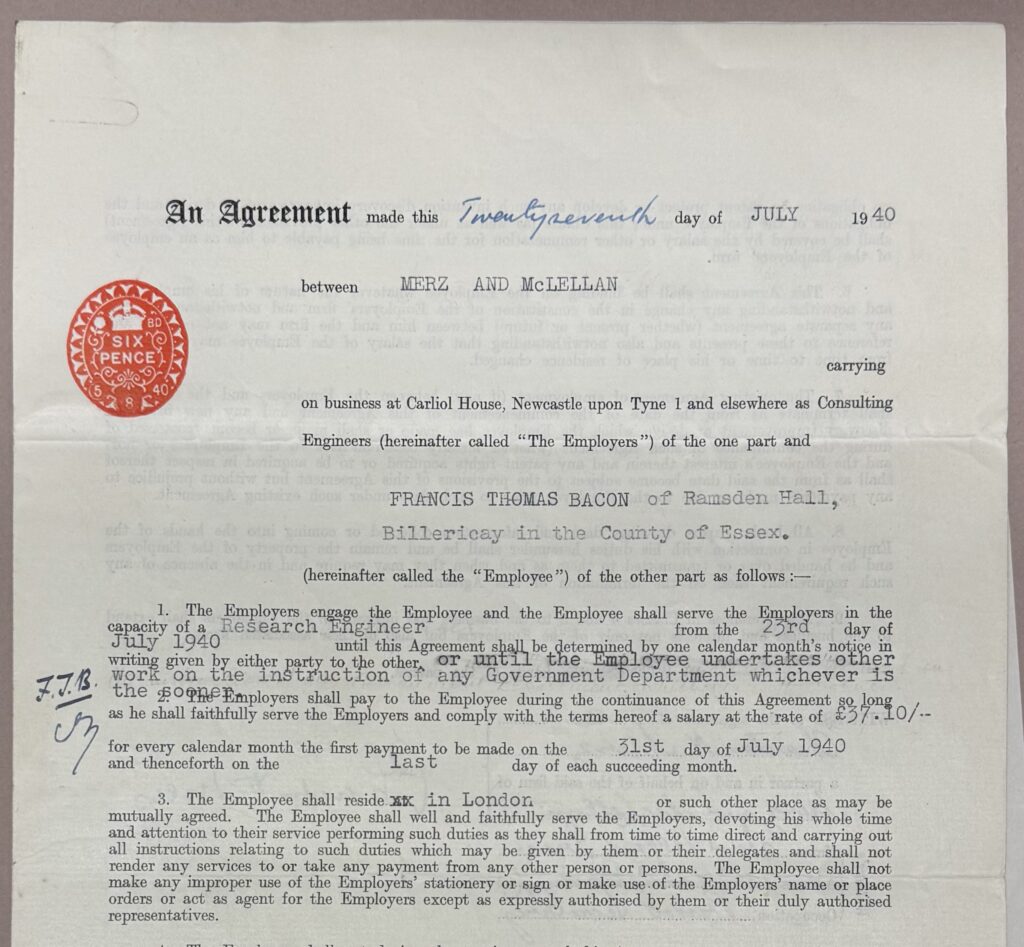
Finally, the archive contains the papers of Tom Bacon, inventor of the fuel cell. Merz and McLellan partly funded his research. The agreement between Bacon and the firm is there in his papers. Its existence reveals another important facet of Charles – his strategic approach to research and development in order to continually expand the use and capabilities of electricity.
Charles was killed, along with his two children, when a bomb destroyed their Kensington home during the Blitz in October 1940.
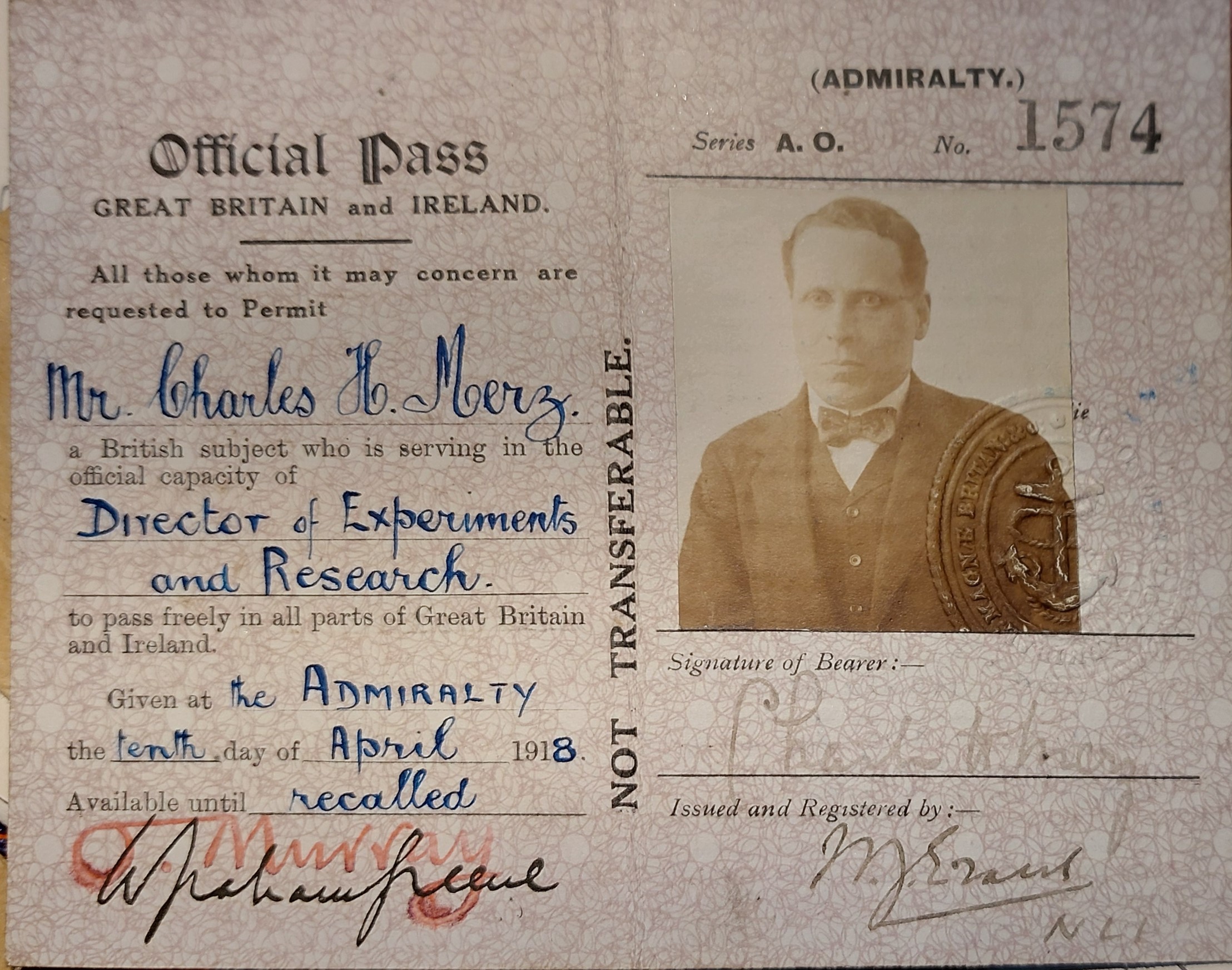
The image at the top of this blog post is Charles Merz’s Admiralty Pass from 1918, issued as he was Director of Experiments and Research. From the Institution of Engineering and Technology (IET) archive. Find out more on IET website about Charles Merz.